Levee — Co-founder & CPO
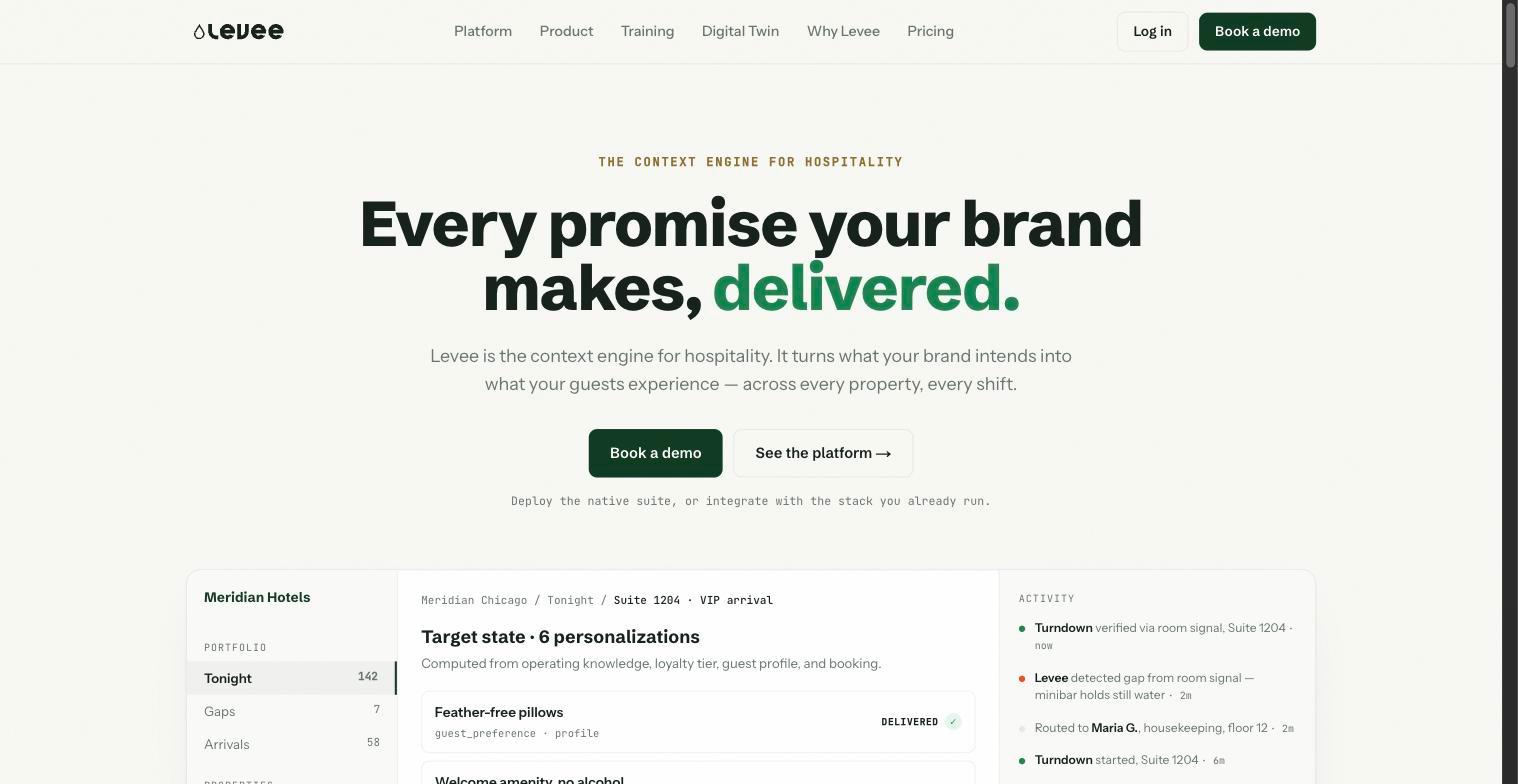
The context engine for hospitality: one live model of a hotel's operation that turns brand intent into what guests actually experience. Computer vision and audio AI cut inspection time 60% during a 605-room Marriott pilot. 15 repositories spanning a Django core with an embedded Rust service, FastAPI agent orchestration, native iOS with ARKit, and Kubernetes on Flux GitOps. Winner of the 2025 Global Startup Pitch (North America) and the $25K HITEC AI Pitch. $750K+ raised.
The Context Engine for Hospitality
I co-founded Levee and built its tech stack. A modern hotel already runs on capable systems—booking, guest profile, task, training record—and each holds a real piece of the truth while none holds the whole. Levee is the layer that connects what they collectively know into one live model of the operation, then closes the gap between what the brand promised and what the guest got. AI bolted onto fragments can only automate fragments; given the whole model, it can actually act.
Concretely: computer vision and audio AI inspect rooms and flag the broken fixtures, cleanliness problems, and unmet preferences that used to need a person with a clipboard. During a 605-room Marriott pilot it cut inspection time 60%. The platform now spans operations, staff training, and a digital twin of the property.
Recognition
- Global Startup Pitch winner (North America), Phocuswright Europe 2025
- Named one of PhocusWire's Hot 25 Travel Startups for 2025
- Won the $25,000 AI Pitch Competition at HITEC 2025
- People's Choice winner, 1871 AI Innovation Lab Pitch Expo
- Skift 2025 Idea Award finalist; HITEC TechOvation AI Award nominee
- Provisional patents secured; $750K+ raised
The architecture, honestly
Fifteen repositories, and I have my hands in all of them. The interesting parts are where the constraints forced a real decision:
- Django core with an embedded Rust service. The domain API, Celery workers, and OpenAPI contract live in Python. The paths that couldn't afford Python latency became a Rust “Accelerated Core” nested in the same repo, with its own CI and Flux image policy. Schema changes have to land before the Rust code that reads them—an ordering rule learned the expensive way.
- Two FastAPI services for AI. An event-driven Agent Engine that submits actions through the core, and an AI Adapter that normalizes providers so a model swap is a config change rather than a refactor.
- Vision models in production. Both YOLO and transformer-based RT-DETR detection, with automated FinOps scheduling on Vertex AI endpoints so idle inference capacity stops billing.
- Native iOS, not a wrapper. The field client is Swift/SwiftUI with ARKit scanning, talking to both the core API and the Rust service directly.
- An MCP server over the platform. Core, Agent Engine, and AI Adapter exposed to AI agents through one facade—which is how the platform became something agents can operate, not just humans.
- Narrated course video, rendered async. A Remotion worker on Cloud Run that the core hands validated jobs to, then adopts its tenant-partitioned GCS status manifest.
Off AWS, onto Kubernetes
The original infrastructure was Terraform on AWS—ECS Fargate, RDS, ECR, Route 53. It now runs on GCP under Kubernetes with Flux and Kustomize as the GitOps source of truth, and the Terraform estate is a read-only archive. Deploys are declarative, image policies are automatic, and the set of things that require a human at a console got much smaller.
Business outcome
A +90% gross margin swing across three initiatives, driven by roadmap sequencing, infrastructure cost work, and technical partnerships. I also built the BI layer (Next.js/React/Recharts) that made franchise comparisons and executive reporting possible for multi-location clients.
My role: Co-founder and Chief Product Officer. I owned product strategy and executed the technical build from inception—models, services, infrastructure, and the apps on top.
Sources: Global Startup Pitch Winners 2025 | PhocusWire Hot 25 Travel Startups for 2025